
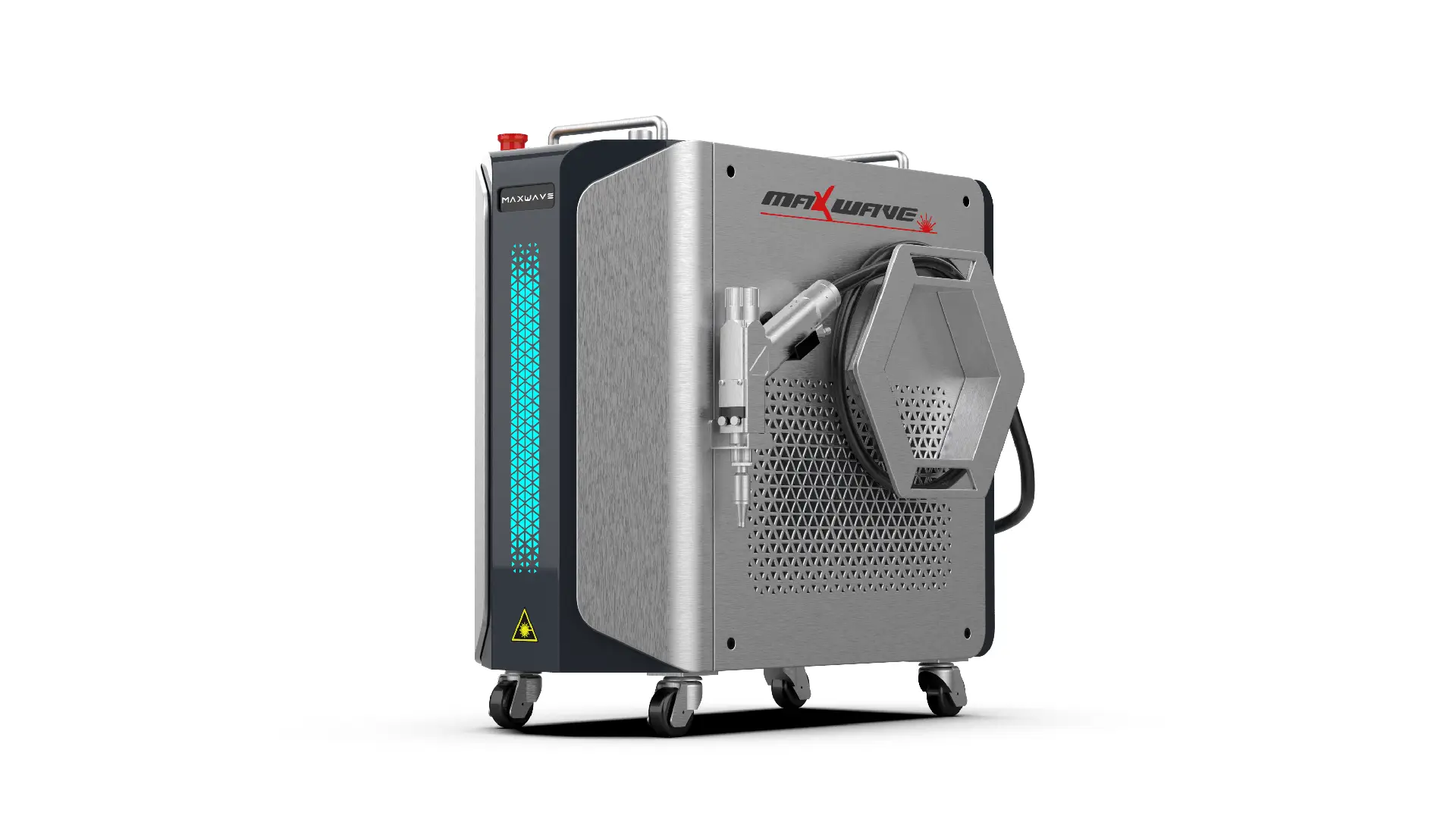
Choosing a handheld laser welder for a small workshop should be simple—but it isn’t. With dozens of brands claiming to be “the best,” the real risk is choosing wrong: overheating machines, poor support, or costs that strain your budget.
The bigger issue isn’t price—it’s total cost. Small shops switching to handheld fiber laser welding report up to 45% faster production, 60% lower material costs, and first-pass yield improving from 87% to 98%. With no grinding, minimal heat distortion, and just 2–4 hours of training, even new operators can reach stable output in weeks.
This is the real budget logic: not what you pay upfront, but what you save from day one. Based on in-depth testing and analysis, we’ve selected 10 handheld laser welder brands that truly fit small, lean workshops—giving you a clear, practical buying guide.
Top 10 Handheld Laser Welder Brand Comparison Table: Side-by-Side Specs for Small Workshops
Ten handheld laser welding brands. Eight dimensions. One table that cuts through the noise.
| Brand | Power (W) | Weight (kg) | Cooling | Price (USD) | Laser Source | Functions | Workshop Rating |
|---|---|---|---|---|---|---|---|
| MaxWave MW-HW | 800–2000 | 56 | Air/Water | $2,950–$5,200 | Fiber | Weld/Cut/Clean | ★★★★★ |
| Herolaser T1 | 1000–2000 | 18 | Air/Water | $4,000–$6,000 | Fiber | Weld/Cut/Clean | ★★★★★ |
| Riselaser | 1500–3000 | 40–55 | Air/Water | $5,000–$12,000 | Fiber | Weld + Wobble | ★★★★★ |
| Han’s Laser HW | 1000–3000 | 40–60 | Water | $4,000–$8,500 | Fiber | Weld/Cut/Clean | ★★★★☆ |
| IPG LightWELD | 1500–2500 | 50–70 | Water | $10,000–$20,000 | Fiber | Weld/Clean | ★★★★ |
| SENFENG | 800–1500 | ~45 | Water | $10,000–$20,000 | Fiber | Weld/Cut/Clean | ★★★★ |
| Coherent FL-ARM | 1000–2500 | 45–65 | Water | $12,000–$25,000 | Fiber | Weld + Dual Beam | ★★★★ |
| LaserStar HWR | 150–450 | 20–35 | Air/Water | $8,000–$15,000 | Fiber/Nd:YAG | Micro-weld | ★★★★☆ |
| TRUMPF TruLaser | 1000–4000 | 50–80 | Water | $15,000–$30,000+ | Fiber | Weld + AI/OCT | ★★★★ |
| Dynalasers M/D | 800–1800 | 8 | Air | Contact | Fiber | Weld/Cut/Clean | ★★★★☆ |
Three numbers tell you if a machine fits a small workshop: weight under 50kg, price under $10,000, power between 1000W–2000W. Most shops running repairs, prototyping, or light fabrication stay well within that range.
- Air-cooled beats water-cooled for flexibility — MaxWave and Dynalasers need no water hookup at all. You can move them around freely.
- Every brand on this list handles stainless and carbon steel up to 4–8mm at 2000W. No exceptions.
- Wobble welding is available on IPG, Han’s, and Riselaser. It helps bridge fit-up gaps without extra prep work.
- MaxWave leads on the three things small workshops care about most — lightest weight-to-power ratio, lowest starting price, and air-cooled portability. No water setup needed.
1. MaxWave MW-HW Series — Best All-Around Handheld Laser Welder for Small Workshops
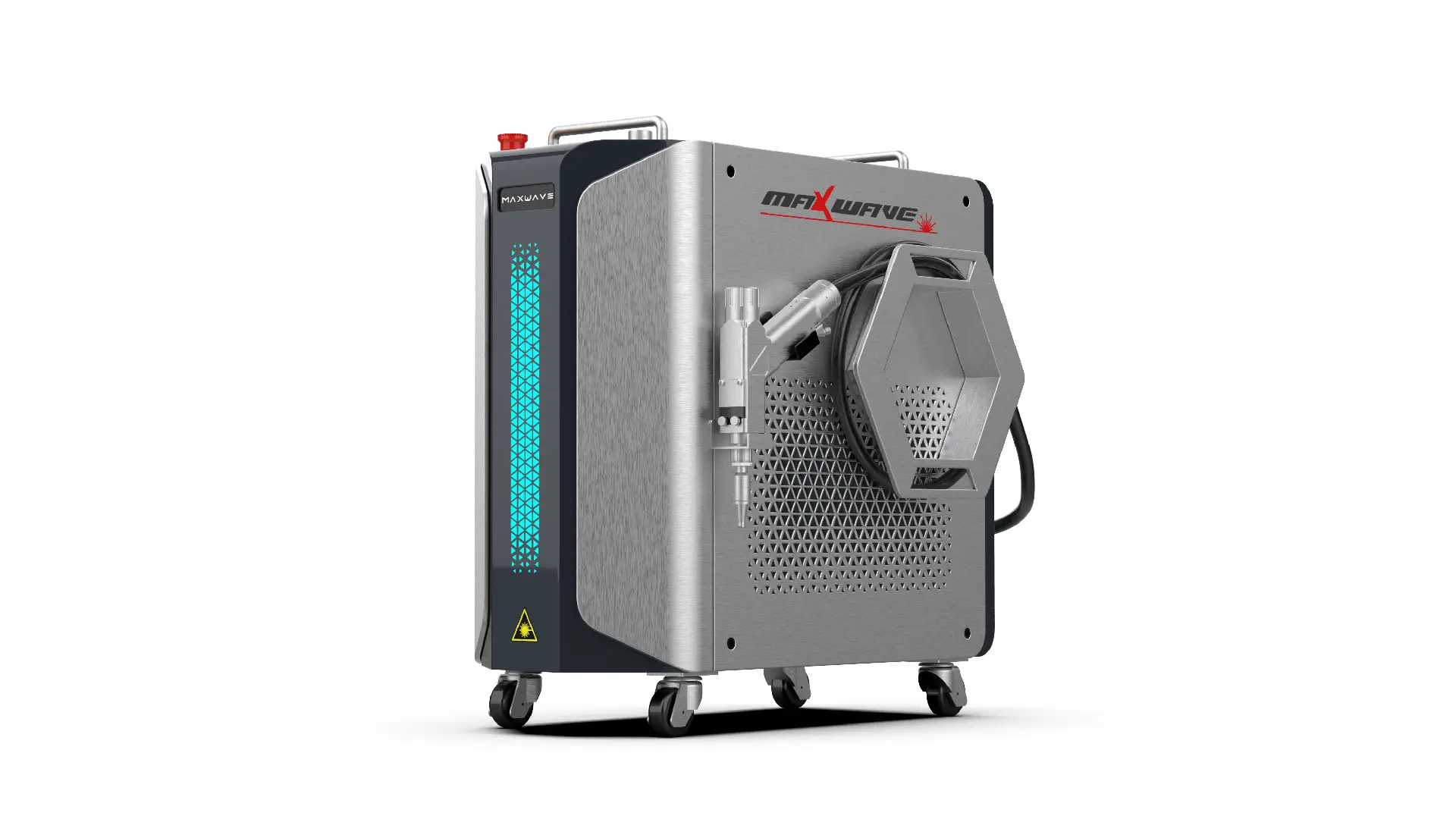
56 kilograms. That’s the number that puts every other laser welding machine on this list in an awkward spot.
Han’s HW Series weighs 275kg and needs a water-cooling system before it welds a single seam. The MaxWave MW-HW? It weighs 52kg. Plug it into a standard 220V outlet. You’re running production welds in under 10 minutes. Same fiber reach — 10 to 15 meters — at one-fifth the footprint.
Floor space is valuable in a small workshop. That math speaks for itself.
The MW-HW series runs 800W to 2000W. It handles stainless, carbon steel, galvanized, and aluminum up to 8mm. Air-cooled. No water loop. No extra infrastructure needed. The 1500W model cuts through 4mm stainless and 4mm aluminum. Those are the two materials that drive most custom fabrication and auto repair jobs.
Pricing sits between $2,950 and $5,200 — on par with Han’s comparable units. But you skip the weight penalty and the cooling setup entirely.
Seams come out clean. No deformation. No post-grind. The heat-affected zone stays tight. That matters a lot on thin-sheet galvanized automotive panels or precision stainless fittings — where heat control makes or breaks the job.
Best for: Sheet metal fabrication, auto body repair, custom aluminum work, small-batch production.
2. Herolaser T1 3-in-1 — Top Choice for Budget-Conscious Workshops Under $6,000
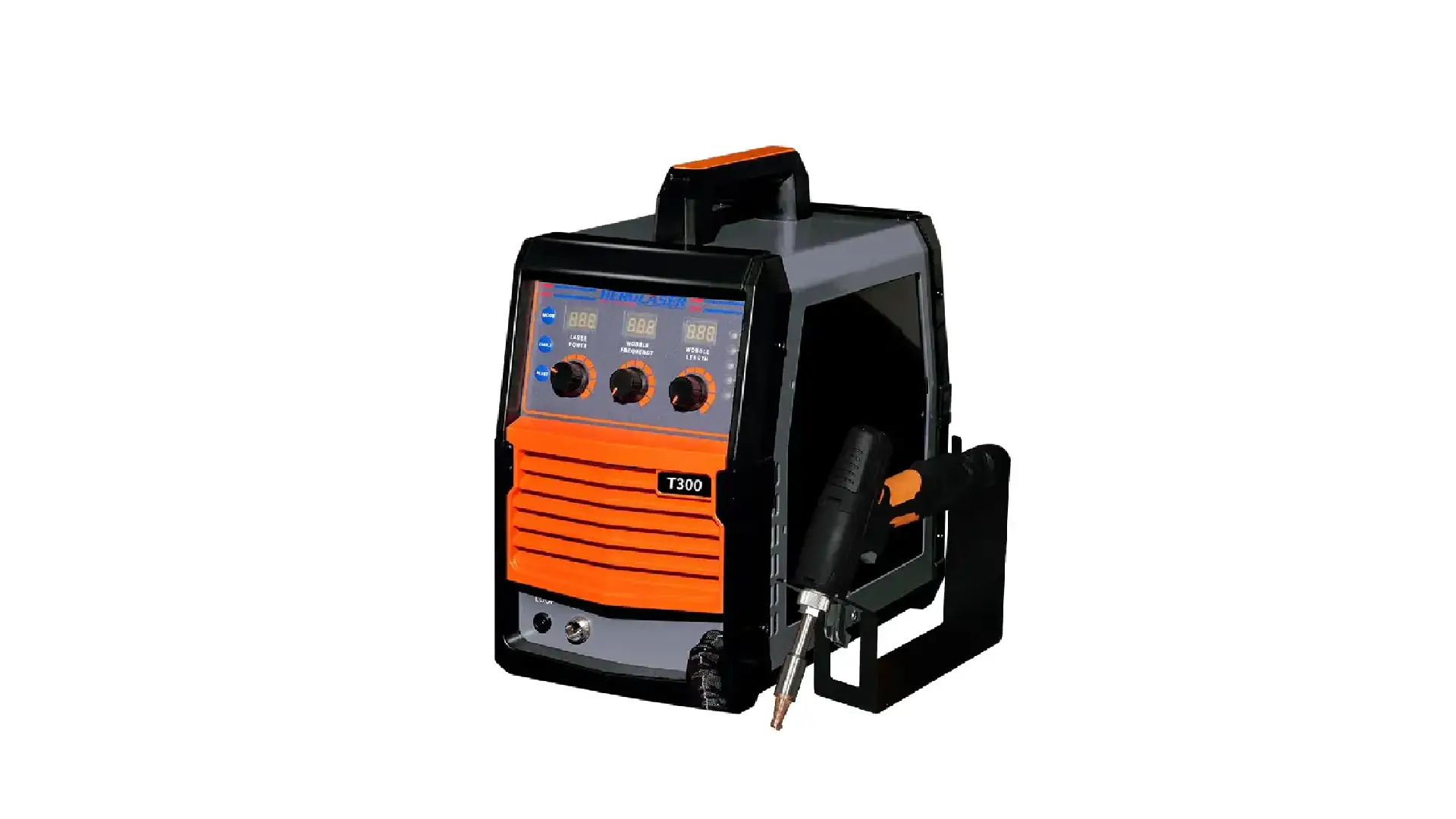
Three tools. One machine. Under $6,000.
That’s the pitch for the Herolaser T1 — and it holds up. Most budget laser welders do one thing. The T1 welds, cuts, and cleans. So you’re replacing a TIG setup ($1,500–$3,000), a cutting system, and a rust removal tool — all in one purchase.
At 18kg with built-in air-cooling, it runs on standard 110V input. No water chiller needed. No infrastructure changes. Just plug in and go.
Where it earns its price:
- Thin-gauge stainless under 1.5mm — clean welds, minimal discoloration, no post-grind needed
- Rust and paint removal — strong, reliable performance on restoration work
- Carbon steel up to 4mm in a single pass
Where it has limits:
- Cutting tops out at 1.5mm sheet metal
- Not built for heavy structural plate work
The smartphone app is a real bonus. You get parameter adjustment, real-time monitoring, and saved settings for repeat jobs. That’s a level of process control most sub-$6,000 machines skip entirely.
Best for: Light fabrication, restoration shops, jewelry and thin-metal work, first-time laser welder buyers.
3. Dynalasers M/D Series — The Lightest Handheld Laser Welder at 8kg
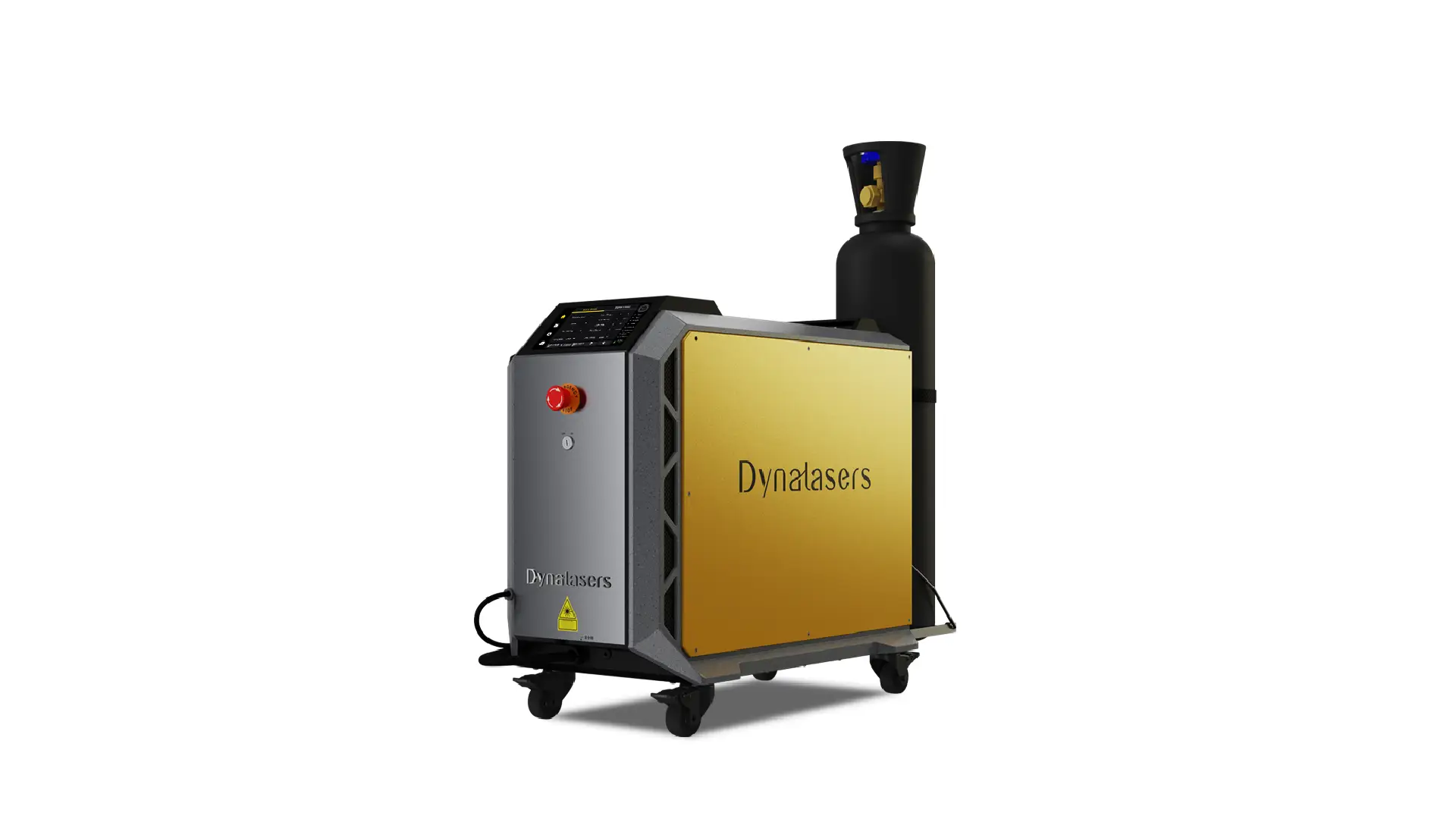
8 kilograms. Pick it up with one hand. Move to the next station. Keep working.
That’s the Dynalasers M/D Series. No other handheld fiber laser welder on this list comes close to that weight. Air-cooled chassis, optimized frame materials — every design choice serves one goal: keeping you mobile.
It runs 800W to 1800W continuous wave. Stainless, carbon steel, aluminum, brass, copper, galvanized — all covered, up to 8mm depth. You get welding, cleaning, and cutting in one unit. It handles temperatures from -15°C to 40°C. Harsh workshop conditions are no problem.
The 2-year warranty gives small shops real buying confidence. Every dollar counts, and this covers you.
Best for: Field repair crews, multi-station workshops, and any operation where moving around isn’t a sometimes thing — it’s the whole job.
4. Han’s Laser HW Series — High-Speed Production Powerhouse for Growing Small Shops
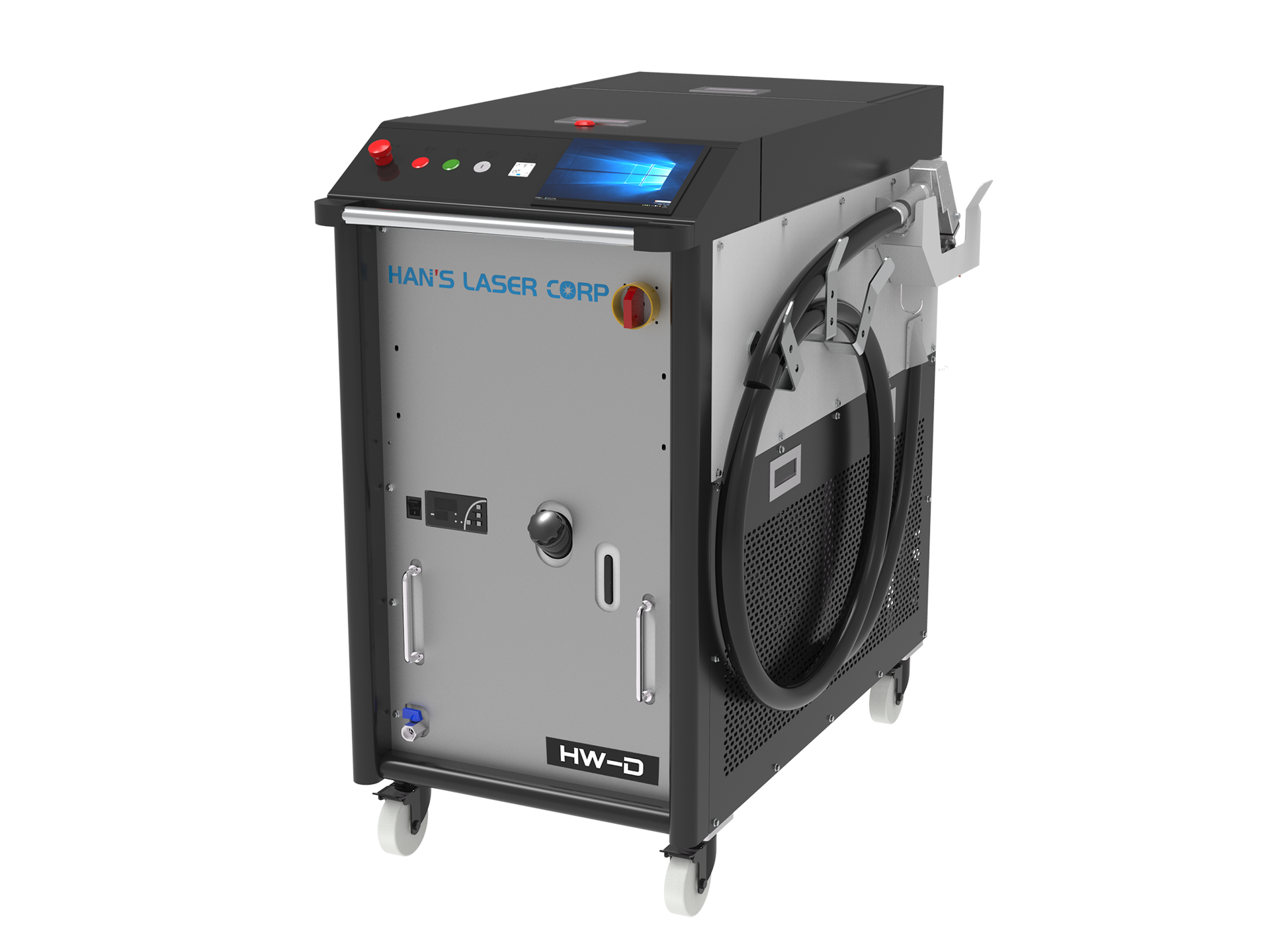
Han’s Laser built its reputation on one thing: speed that holds up under real production pressure.
The HW Series runs at 120mm/s — four times faster than TIG. At that pace, one machine replaces two welders per year. For a growing shop handling higher order volume, that math changes everything.
Power options come in 1kW, 1.5kW, and 2kW. The 2kW model cuts through 5mm plate on stainless, carbon steel, and galvanized without breaking a sweat. You get clean seams. Little to no polishing required. Pricing falls between $4,000–$8,500 — solid value for the output you’re getting.
The tradeoff is real, though: 275kg. Water-cooled. Fixed-station setup. This machine stays put — you build your workflow around it.
Best for: High-throughput fixed-station shops ready to push production volume up.
5. IPG Photonics LightWELD — Most Reliable Handheld Fiber Laser Welder for Precision Work
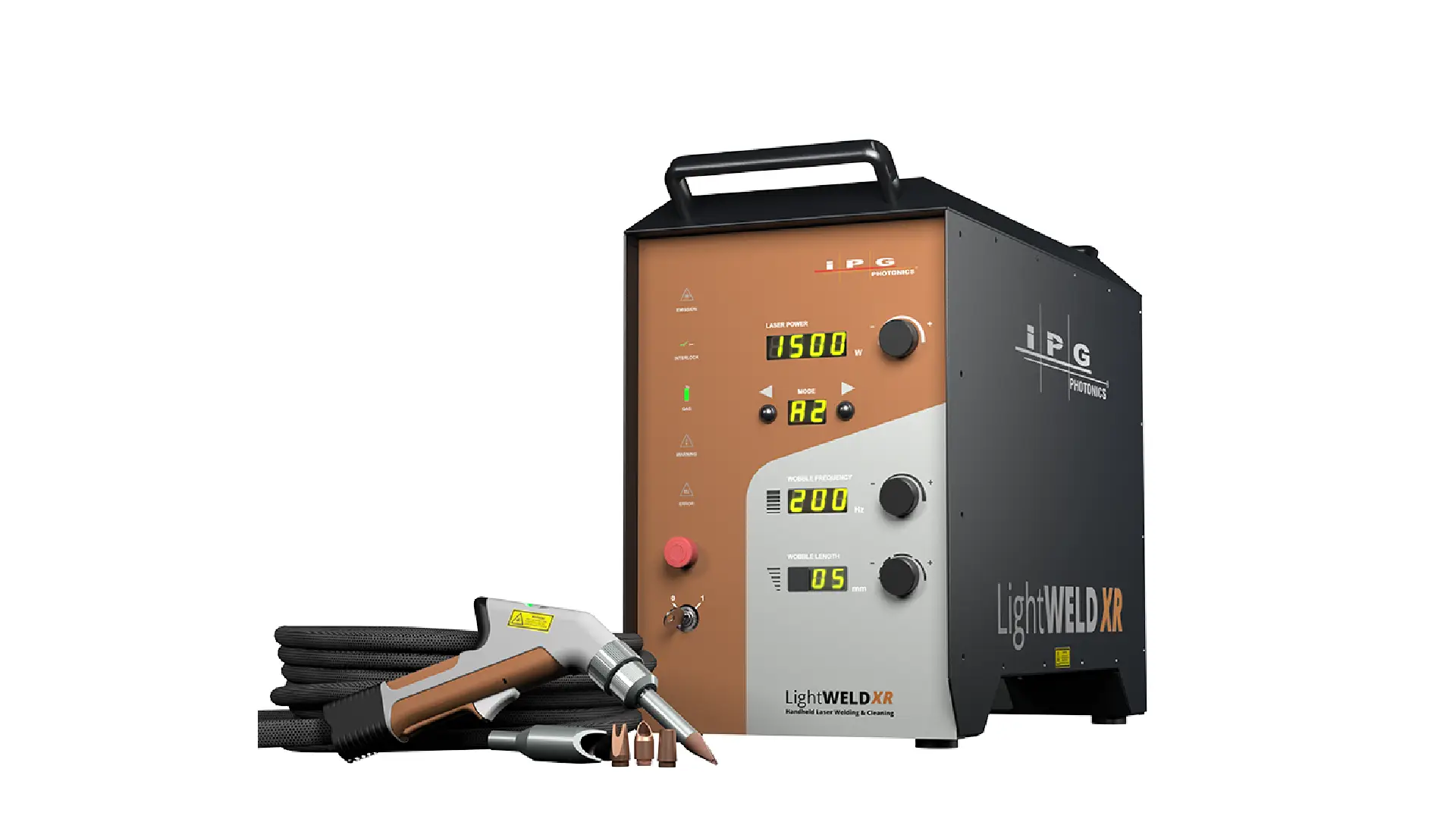
IPG Photonics didn’t build the LightWELD for everyone. They built it for the shop that can’t afford a bad weld.
Precision machining. Custom titanium parts. Dissimilar metal joints where one degree of distortion ruins the whole piece. That’s where this machine lives.
The core specs: 1500W continuous, 2500W peak. Air-cooled. 100% duty cycle — no thermal throttling mid-job. You get full support for welding stainless, aluminum up to 8mm, galvanized steel, and nickel alloys. It also handles reflective metals that damage lesser machines.
The wobble function works well — not just on paper. You get up to 5mm weld width and 300Hz wobble frequency on the XR model. Poor fit-up gaps that would wreck a standard bead? The LightWELD handles them without losing the bead quality.
100 programmable presets — 75 are built-in for common materials and thicknesses. That means repeatable results across every operator and every shift. No guesswork, no inconsistency.
The price is real: $10,000+. Budget-sensitive shops should look elsewhere on this list.
Your work involves reflective metals or tight tolerances? Clients who reject anything less than perfect? This machine protects your reputation. It holds quality where other tools start to slip.
Best for: Precision fabrication, aerospace components, custom high-end metalwork, and shops where weld quality is non-negotiable.
6. SENFENG Laser — Versatile Handheld Laser Welder with Strong Global Service Network
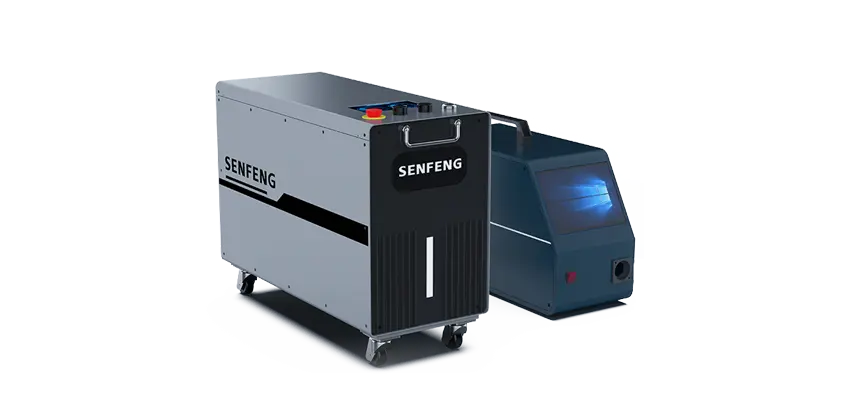
Serious buyers notice SENFENG’s global reach right away. And they don’t forget it — especially at 11pm the night before a deadline.
Three core models cover most small workshop needs: the SF3S (0.8kW), SF4S (1.2kW), and SF5S (1.5kW). Stainless up to 8mm. Carbon steel up to 6mm. Aluminum and galvanized up to 5mm. All run at speeds up to 120mm/s. The welding gun weighs under 0.7kg — lighter than most TIG torches.
Three core models cover most small workshop needs—the SF3S (0.8kW), SF4S (1.2kW), and SF5S (1.5kW)—making them a strong contender for the best handheld laser welder for small workshop applications. Stainless up to 8mm. Carbon steel up to 6mm. Aluminum and galvanized up to 5mm. All run at speeds up to 120mm/s. The welding gun weighs under 0.7kg—lighter than most TIG torches.
SENFENG stands out from other mid-range options because of its service setup. You get 24/7/365 live technical support in the US. There’s a 30-day money-back guarantee. Plus, a 1-year warranty with real contact channels — not a dead inbox.
Pricing sits higher than budget-tier options. Expect quotes in the $10,000–$20,000 range, based on power configuration. That extra cost gets you a full support network — not just the machine itself.
Best for: Small workshops that put after-sales reliability first. Also a solid pick for operators running critical jobs where downtime is not an option.
7. Riselaser — Most User-Friendly Handheld Laser Welder for SME Operators
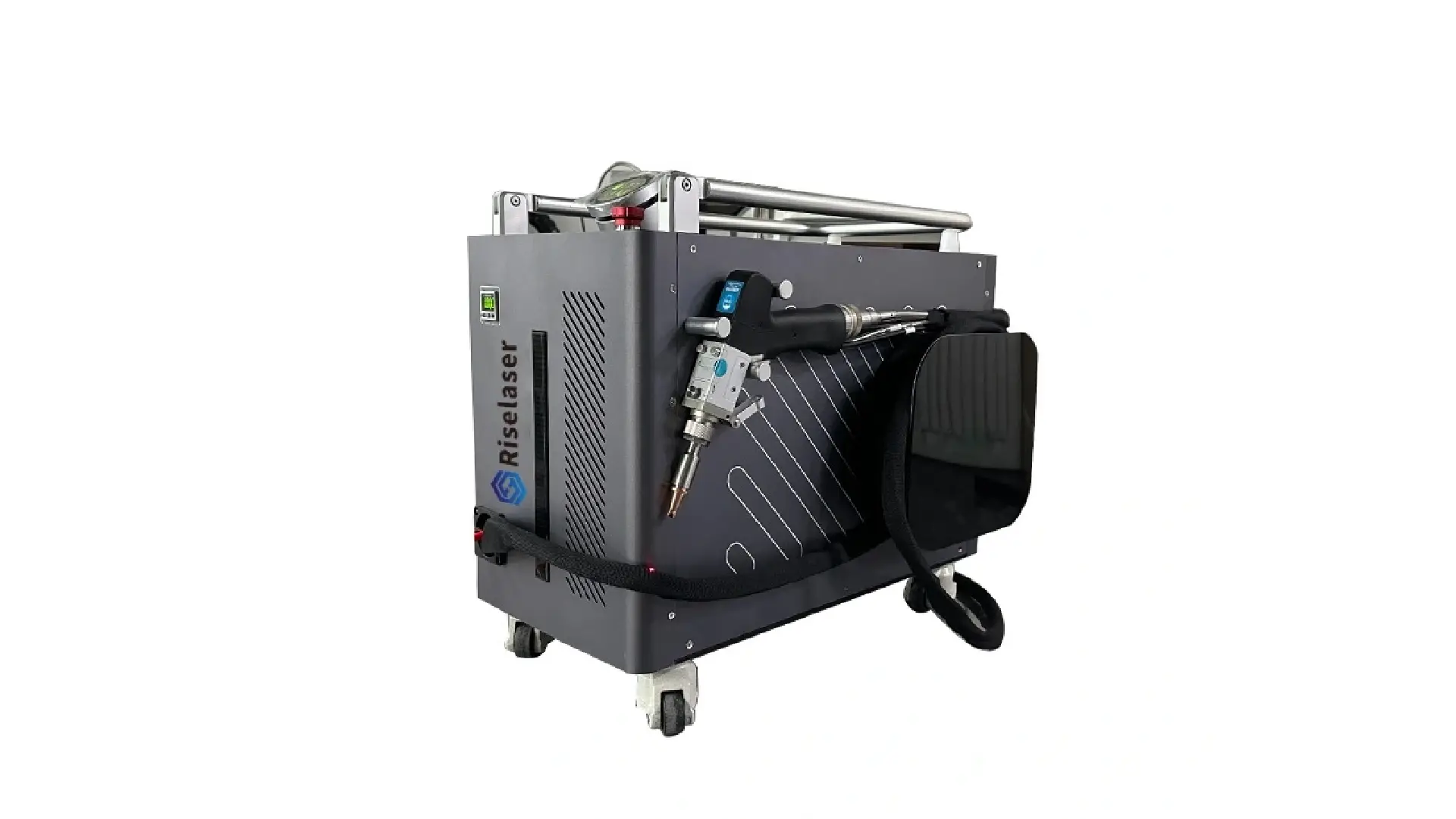
Riselaser built this machine around one core idea: the person running it isn’t a laser specialist.
Eight preset welding modes cover every joint type a small fabrication shop runs into — butt welds, T-fillets, corner joints, lap welds. No manual parameter hunting. Pick your joint, set your material, start welding.
Power ranges from 1500W to 3000W. You get stainless and carbon steel up to 7mm. Aluminum and copper go up to 4mm. Titanium and brass are both supported. The 4-in-1 setup covers welding, cutting, seam cleaning, and surface cleaning. That’s four functions in one unit — fewer laser welding machines eating up your floor space.
Two cooling options are available:
– RL-FLA (air-cooled) — stays light and needs zero maintenance. Good for on-site jobs or tight spaces.
– RL-FB (water-cooled) — built for higher-throughput production runs.
Laser sources come from BWT, Raycus, MAX, or JPT. All are rated to 100,000 hours of use.
Speed reaches up to 120mm/s. You also get a claimed 70% efficiency gain over traditional welding methods. Weld quality stays clean — low heat input, no deformation.
Best for: SME operators who want straightforward controls, multi-material flexibility, and a machine any team member can pick up and run from day one — no expert required.
8. LaserStar HWR Series — Precision Micro-Welding for Jewelry & Medical Small Workshops
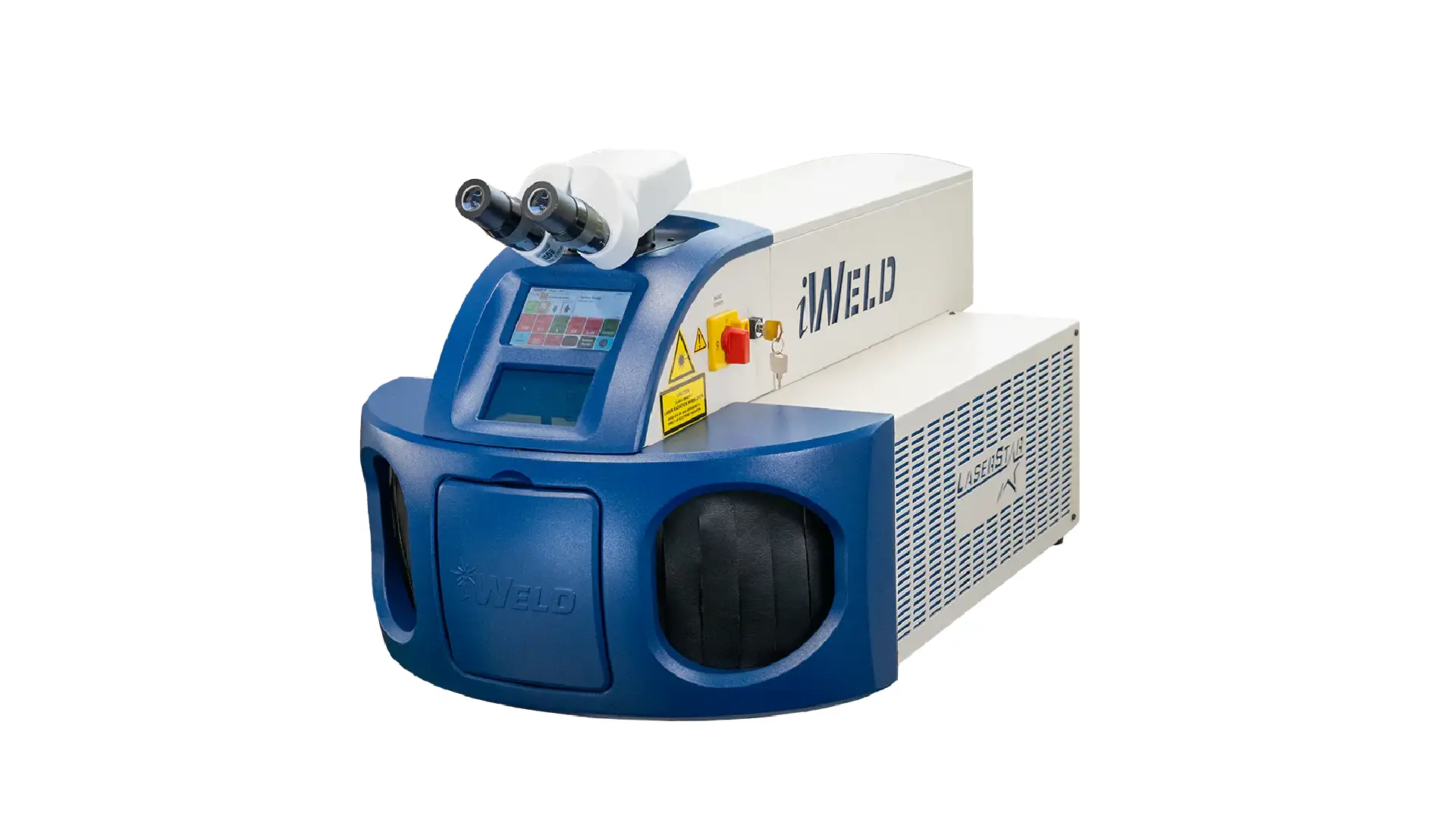
A 0.05mm weld bead. That’s thinner than a human hair. For jewelry benches and medical device workshops, that number matters more than anything else.
The HWR Series laser welder runs 80–200W (Nd:YAG) and 150–450W (fiber). Low power isn’t a weakness here. It’s the entire point. Less heat means no warping on thin walls. No sink lines on polished gold surfaces. No damage near heat-sensitive components. Pulse stability holds within ±0.5% — steady, repeatable, and clean every time.
Where it performs:
– Precious metals — gold, silver, platinum — no polishing prep required
– Medical hermetic seals and miniature electronics
– Mold repair on tight slots and edges
– Spot welds under 100μm on fine components
The 6-axis robot option is worth a look. You can switch between handheld and robotic mode. Add a CNC workstation on top of that. So a small workshop can step toward automation without tearing the facility apart.
Price starts above $20,000. This isn’t a general fabrication machine. It’s a specialist tool — built for shops where one bad weld ruins a $3,000 custom piece.
Best for: Jewelry repair studios, medical device assemblers, and mold shops where micro-precision is non-negotiable.
9. Coherent HighLight FL-ARM — Superior Beam Quality for Demanding Workshop Applications
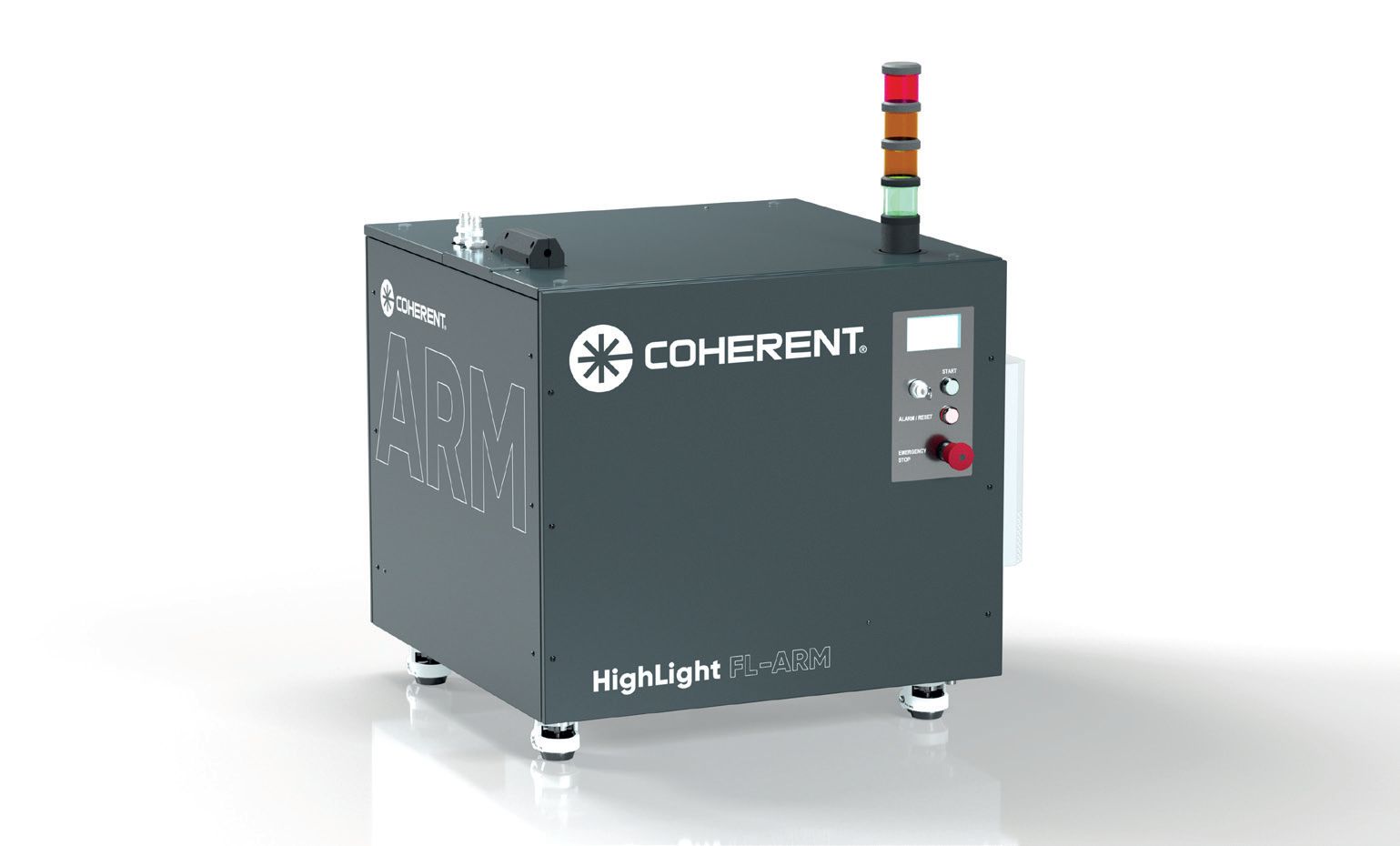
Most laser welders give you one beam. Coherent gives you two — and that changes what’s possible.
The HighLight FL-ARM uses a dual co-axial setup. You get a center beam up to 2.5 kW and an outer ring beam up to 7.5 kW. Both run from a single fiber, and you can control each one on its own. Spatter drops 70–80% compared to standard fiber lasers. Heat-affected zones shrink. Reject rates fall.
Cutting high-strength steel, aluminum, or copper? These materials push lesser machines to their limits. That beam precision is what separates a clean seam from a scrapped part.
The tradeoff is real: Power models start at 2 kW and scale up to 10 kW. This is not a compact shop machine. It’s precision infrastructure — built for serious work, and priced to match.
Best for: Advanced fabrication shops working with reflective or high-strength metals. Beam quality drives the buying decision here, not price.
10. TRUMPF TruLaser Station 7000 — Industrial Precision Reference (Why Most Small Shops Should Skip It)
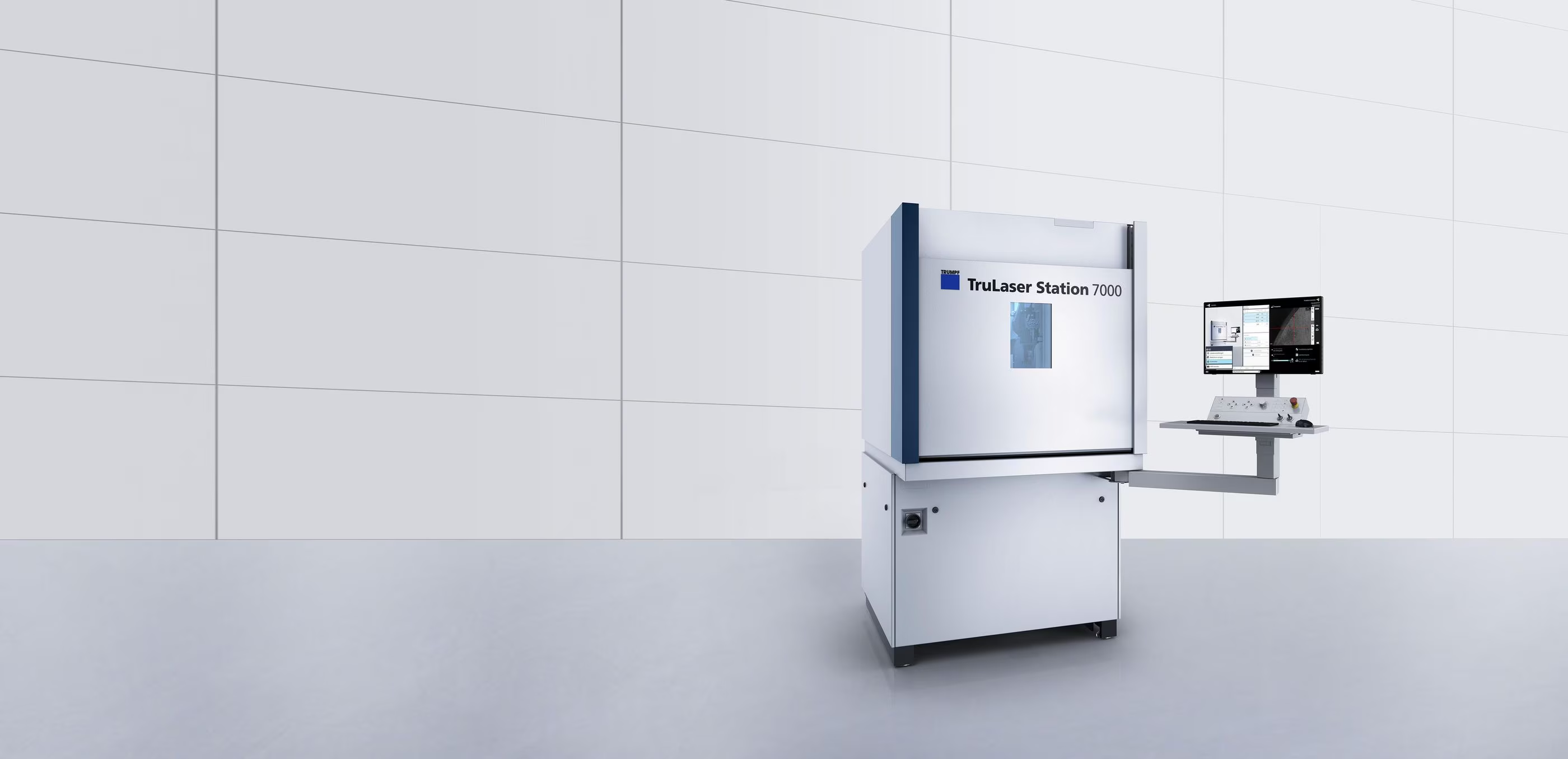
3,500 kilograms. 12 kW dedicated power. A price tag that starts at $100,000 and climbs past $350,000 once you add optics, rotary table, and integration.
This machine is not for you.
The TruLaser Station 7000 hits 0.03 mm repeatability and 0.08 mm positioning accuracy. Built-in camera systems read component geometry and place welds with no post-processing needed. It handles bronchoscopes, battery cells, and Direct Copper Bonds on ceramic substrates. These are jobs where one bad seam scraps a medical device or triggers a product recall.
That’s real industrial precision. It’s also dead weight for a shop running stainless fittings or aluminum panels.
The ROI numbers are brutal. Shops doing fewer than 1,000 welds per year face a 10+ year payback period. Annual maintenance alone eats 10–15% of the purchase price. No sustained series production? The machine sits idle. Idle time kills the math fast.
So why is it on this list? One reason: it marks the ceiling. There’s a clear line between workshop-grade welding (±0.1–0.5 mm) and industrial-grade automation. Knowing where that line sits stops you from second-guessing your own setup. A MaxWave handheld fiber welder at $4,000–$8,500 gives you ±0.1–0.2 mm accuracy. For 99% of small workshop jobs, that’s all the precision the work demands.
Best for: Aerospace R&D labs, medical device manufacturers, and high-volume energy component lines. Not a small shop.
Handheld Laser Welder Buyer’s Guide: How to Choose the Right Brand for Your Small Workshop
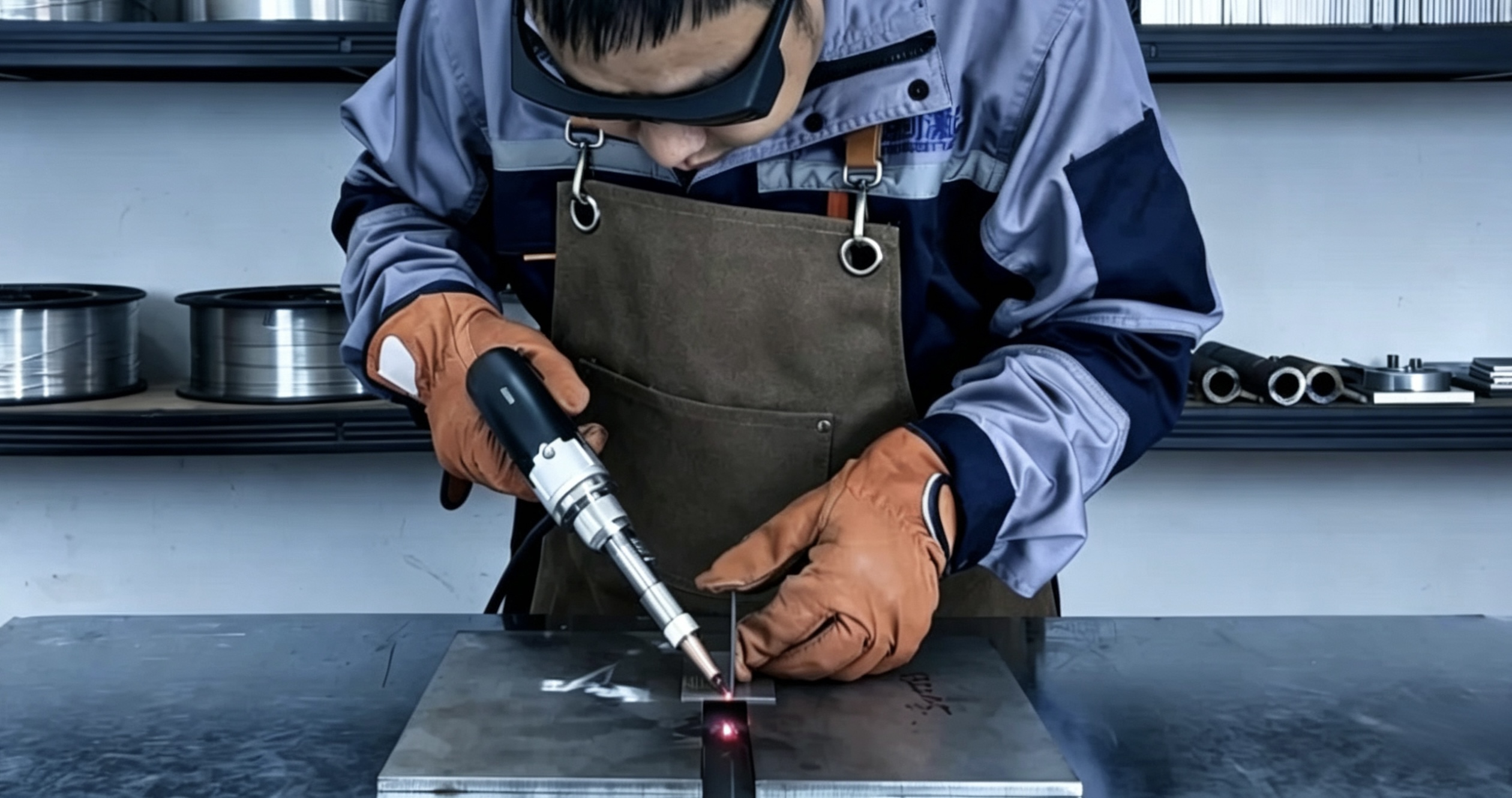
Most workshops end up with the wrong machine. Not because they picked a bad brand — because they matched the specs to the wrong job.
Here’s a simpler way to decide.
Match power to your material first.
| Power | Max Thickness | Best Fit |
|---|---|---|
| 1000W | ~3mm | Thin sheet, decorative, electronics |
| 1500W | ~5mm | 90% of small workshop jobs |
| 2000W+ | 5mm+ | Heavy automotive, structural plate |
1500W covers 90% of small workshop jobs. No need to pay for 2000W unless your work demands it.
Then filter by budget.
- Under $6K: MaxWave or Herolaser. Solid 1500W output, air-cooled, ready to run.
- $6K–$10K: MaxWave high-config or IPG entry. These handle thicker plate and a wider range of materials.
- $10K+: Coherent or LaserStar — go here if a client requires precision certification. Otherwise, skip it.
Two more things that trip up small shop buyers:
- Cooling setup. No stable water source? Stick with air-cooled — MaxWave or Dynalasers fit that need. A water chiller needs dedicated space and a consistent supply line. Don’t guess on that.
- Reflective metals need wobble function. Aluminum and copper will give standard beams trouble. The beam scatters instead of penetrating. IPG and Riselaser both include wobble function — check that box before you buy.
Ask the supplier for a live video weld demo on your exact material thickness before placing any order. Specs on paper can mislead. A live demo shows you the real result.
FAQ: Small Workshop Owners’ Top Questions About Handheld Laser Welding Machines
These four questions come up every time someone serious about buying a handheld laser welder starts their research. Here are straight answers.
Q: Can a complete beginner run one of these machines?
Yes — with one condition. Test on scrap first.
Handheld laser welders use touch screens to set power, speed, and wire feed. Brands like MaxWave and Herolaser include preset modes that cut out most of the guesswork. A new operator can produce consistent welds within hours. Technique still matters, though — even with good presets, how you hold and move the gun affects the result. Safety training isn’t optional. It’s the first step, every time, no exceptions.
Q: What power level does a small workshop need?
Match the power to the material. Not the other way around.
| Thickness | Power | What It Handles |
|---|---|---|
| Under 2mm | 1000W | Thin stainless, sheet steel |
| 2–4mm | 1500W | Mild steel, aluminum — most shop work |
| Over 4mm | 2000W | Thicker plate, structural jobs |
For most small workshops, 1500W is the right starting point. It handles the bulk of everyday jobs. You won’t overpay for capacity that sits idle.
Q: What does a capable machine cost?
- $3,000–$5,000: Entry-level 1000W units. Solid for light work.
- $4,500–$7,000: Mid-range 1500W. The sweet spot for most shops.
- $6,000–$10,000: 2000W premium units. Built for heavier, higher-volume work.
Every price tier includes nozzles and wire feeders. Maintenance costs stay low. Clean the lenses each week. Check the cooling system on a set schedule. Do those two things, and the machine runs well for years.
Q: Are Chinese laser welding brands reliable?
The top ones, yes.
MaxWave, Han’s Laser, and SENFENG all carry CE and UL certifications. Most offer 2-year warranties with free replacement parts for non-human damage. These machines run in real workshops day after day. The quality holds up against global competitors, IPG included. Certification is the filter — no CE or UL documentation? Move on.
Final Verdict: The Best Handheld Laser Welding Brand for Your Small Workshop
Ten brands. One decision. Here’s how it breaks down.
For most small workshops, MaxWave is the call. It features an air-cooled design, multi-function capability, and a solid 2-year warranty. Even better, it’s priced at just $2,950–$5,200 for 800–2000W—making it one of the most cost-effective options on the market. You get welding, cleaning, and cutting in one machine. One footprint. One streamlined, profit-focused setup.
On a tighter budget? Start with Herolaser. The T1 comes in under $6,000 while still delivering a stable 1500W output.
Always moving between jobs? Dynalasers. Eight kilograms total. Pick it up. Go.
Every other brand on this list targets a specific need — micro-precision, dual-beam output, or industrial throughput. Most shops don’t work at those extremes. Buy for the work you run today, not the work you might run someday.
Ten brands. One decision. Here’s what actually matters.
Conclusion
You came here with a list of brands to evaluate. Now you have something more valuable — a clear picture of what matters for a small workshop budget, and which manufacturers are worth your time.
The honest truth? Most small workshops don’t need a $50,000 industrial system. You need a reliable handheld fiber laser welder that shows up and performs. One that doesn’t require a full-time technician to keep it running. That’s the sweet spot where MaxWave’s MW-HW Series leads — competitive pricing, proven laser sources, and real after-sales support. Support that doesn’t vanish six months after your invoice clears.
Stop over-researching. Your competitors are already welding faster, cleaner, and cheaper than you.
Ready to see what the right laser welding machine for metal fabrication looks like in your workshop? Request a free spec consultation from MaxWave today. Bring your materials, your weld specs, and your budget. They’ll handle the rest.
The best time to upgrade was last year. The second best time is right now.

0条评论